





Introduction
Most brands think they’re struggling with search because algorithms keep changing. That’s rarely the real issue. The bigger problem is that the way people search has changed faster than how brands think about visibility.
Modern search success doesn’t come from reacting to every algorithm change or relying on tools—it comes from understanding your audience, answering their questions with clarity, and showing up consistently across channels. Search engines have simply followed user behaviour—they now reward what feels genuinely useful and quietly filter out what doesn’t.
This is why many businesses see slipping digital search visibility even when they’re “doing SEO.” The tactics haven’t failed; the mindset has.
In this blog, we break down what modern search success actually looks like today, the common gaps brands run into, and the structured approach required to build visibility that holds over time.

Search Success Is No Longer About Rankings Alone
There was a point when ranking felt like winning. You hit page one, reported the result, and moved on. That version of search no longer exists in practice, even if it still exists in reporting decks.
Search results are crowded now. Featured snippets answer questions instantly. Local results dominate service queries. Paid placements, videos, and AI summaries compete for attention before a user even reaches a traditional link.
The issue most brands face isn’t invisibility—it’s ineffective visibility. Pages appear, but users don’t engage. Clicks don’t convert. Traffic doesn’t translate into outcomes. This is where search engine visibility and organic search performance need to be evaluated beyond position.
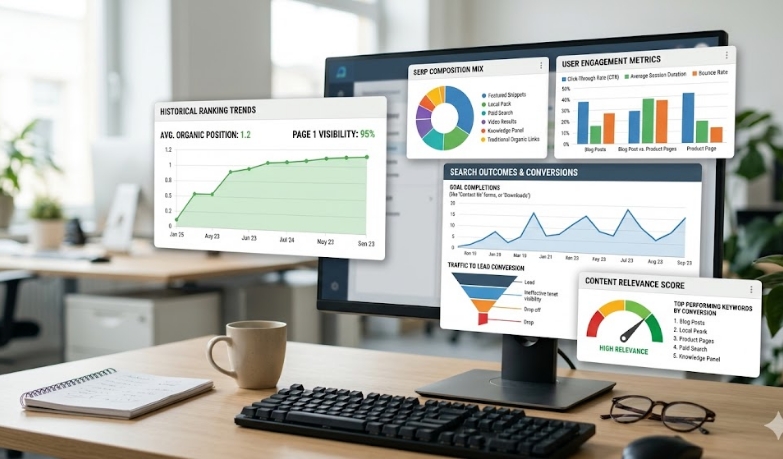
Did you know? Google has confirmed that its systems observe how content performs over time, not just where it ranks initially.
What this means in practice: if users don’t find value, rankings alone won’t protect you for long. Once rankings stop being the finish line, relevance becomes the real measure of success.
User Intent Is the Foundation of Modern Search
Search engines don’t reward content for matching words anymore. They reward it for matching purpose. Understanding user intent in search is no longer a “best practice”—it’s the baseline.
Most search failures happen because brands optimise for what users type, not what they’re actually trying to solve. Someone searching isn’t always looking for information. Sometimes they’re validating a decision. Sometimes they’re comparing options. Sometimes they’re looking for reassurance.
When content ignores that context, performance drops—even if traffic looks healthy.
Trivia! Google introduced RankBrain specifically to interpret unfamiliar or ambiguous queries by understanding intent patterns rather than exact phrasing.
Content aligned with intent feels obvious when you read it. It answers the next question before the user asks it. That’s what search engines recognise as relevance.
Intent, however, only works when the content itself is built with depth and clarity.
Content and SEO Must Work as One Strategy
SEO and content being treated as separate functions is one of the quiet reasons search performance plateaus. An effective SEO and content strategy begins with subject understanding, not keyword selection.
Pages fail when they lack depth, not optimization — search engines now look for content that connects concepts, anticipates follow-up questions, and reflects genuine familiarity with the topic.
Did you know? Industry-wide analyses consistently show that content covering topics in depth performs better over time than fragmented, surface-level pages.
Good content doesn’t feel “optimized.” It feels complete. SEO simply ensures that completeness is discoverable. Even then, content alone doesn’t operate in isolation anymore.
Integrated Digital Marketing Drives Search Visibility
Search doesn’t live on a single page. It lives across platforms, conversations, and signals. This is where an integrated digital marketing strategy becomes essential. Paid media, social activity, and consistent brand messaging have a far greater impact on digital search visibility than many brands realize, as repeated exposure builds user trust. Search engines pick up on that behaviour.
The opposite is also true. Disconnected messaging creates weak signals. Even strong content struggles when it isn’t reinforced elsewhere.
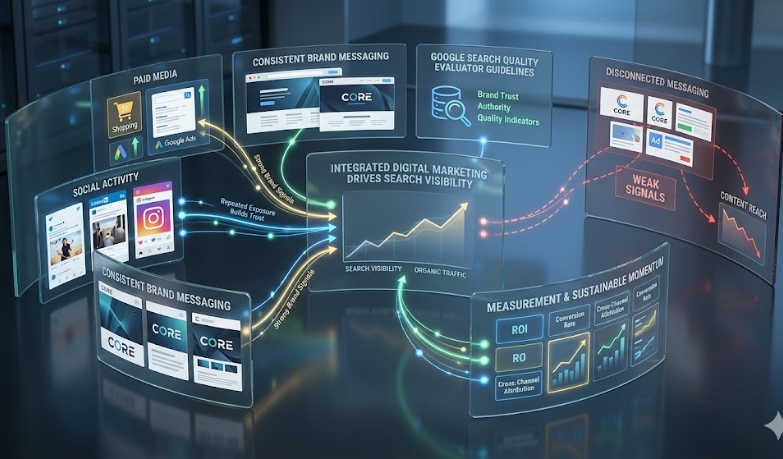
Trivia! Google’s Search Quality Evaluator Guidelines explicitly reference brand trust and authority as indicators of quality.
Integration creates momentum—but sustaining it depends on measurement.

Did you know?
McKinsey has found that data-led organizations are significantly more likely to sustain
long-term growth.
When data guides decisions, search stops being reactive and starts becoming reliable.
Data and Measurement Define Real Search Success
Search performance without analysis is guesswork. A mature search marketing strategy looks beyond traffic and asks harder questions: Are users engaging? Are they returning? Are they progressing?
Many brands still rely on vanity metrics because they’re easy to report. But numbers without context don’t drive improvement.
Teams that priorities data-driven marketing decisions focus on patterns, not spikes. They refine what works, remove what doesn’t, and build resilience into their strategy.
Did you know?
McKinsey has found that data-led organizations are significantly more likely to sustain
long-term growth.
When data guides decisions, search stops being reactive and starts becoming reliable.
Conclusion
What Modern Search Success Really Means for Brands
Modern search success isn’t built through shortcuts. It’s built through understanding of users, intent, content depth, and the wider digital ecosystem. Brands that adapt to this reality don’t just stay visible; they stay credible.
Key Takeaways
- Rankings are signals, not outcomes
- Intent defines relevance
- Content depth builds authority
- Integration strengthens visibility
- Data sustains performance
At Doodlezz, search is treated as part of a broader digital system. Strategy, content, media, and performance are aligned to deliver visibility that translates into business impact—not just traffic.
If you want to understand what modern search success looks like for your brand, our team can walk you through a tailored, insight-led approach.
Request a personalized discussion with Doodlezz and build search visibility that actually lasts.
Why Doodlezz?

We are an integrated marketing partner that combines creative strategy with operational
delivery, identity, guidelines,
packaging, assets, and content built for both digital commerce and offline retail.
Unlike boutique creative studios that
stop at concepts, Doodlezz takes designs through production, vendor liaison, and
campaign ready packaging, reducing
launch friction. In the Oman India market, agencies often specialise in either creative
or execution; Doodlezz’s end to
end model positions it to reduce vendor hand-offs and accelerate time to market.
Build a Brand System that Performs


Krishna Talreja
Tech - Content writer
Apr 03, 2026